How Far Should Trees Be From Your House in Oklahoma?
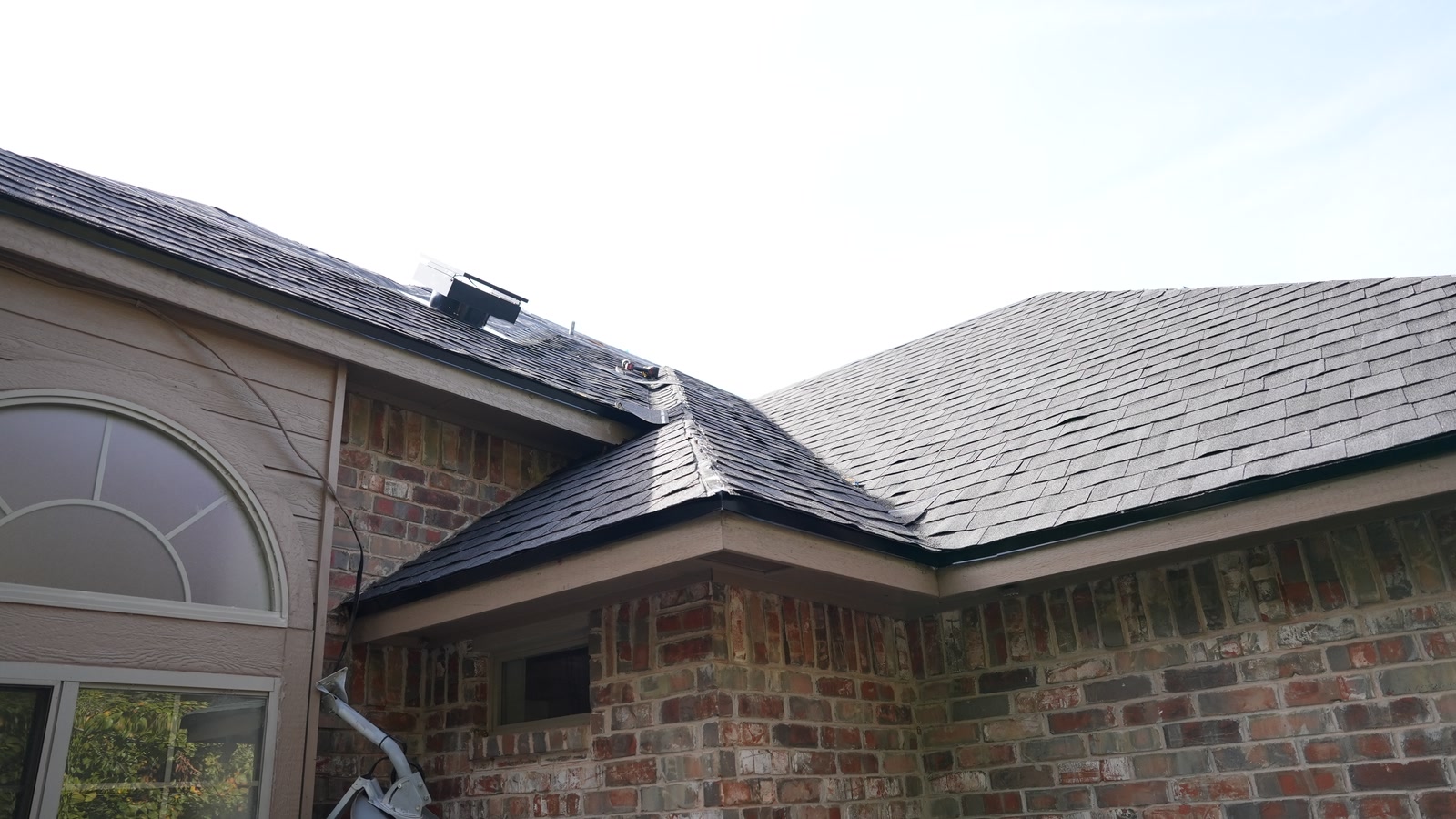
How far trees should be from your house depends on the tree, not on one fixed number. Plant each tree so its full-grown branches will never reach or hang over the roof. Keep large shade trees off to the side, and save short flowering trees for tight spots and areas under power lines. For trees that already overhang the roof, plan trimming by a professional before ice season.
If you've noticed branches resting on your shingles or a limb scraping the roof edge, Black Crown Construction can look it over during a free on-site estimate, and you can see what that work involves on the storm damage repair services page.
How far should a tree be from a house?
The right distance between a tree and a house comes from the tree's size when it is full grown. An Arbor Day Foundation guide shared by the Oklahoma Department of Agriculture lists size and location, including room for roots and branches, as a key factor in choosing what to plant. The guide gives no single distance. A small redbud needs far less room than an oak.
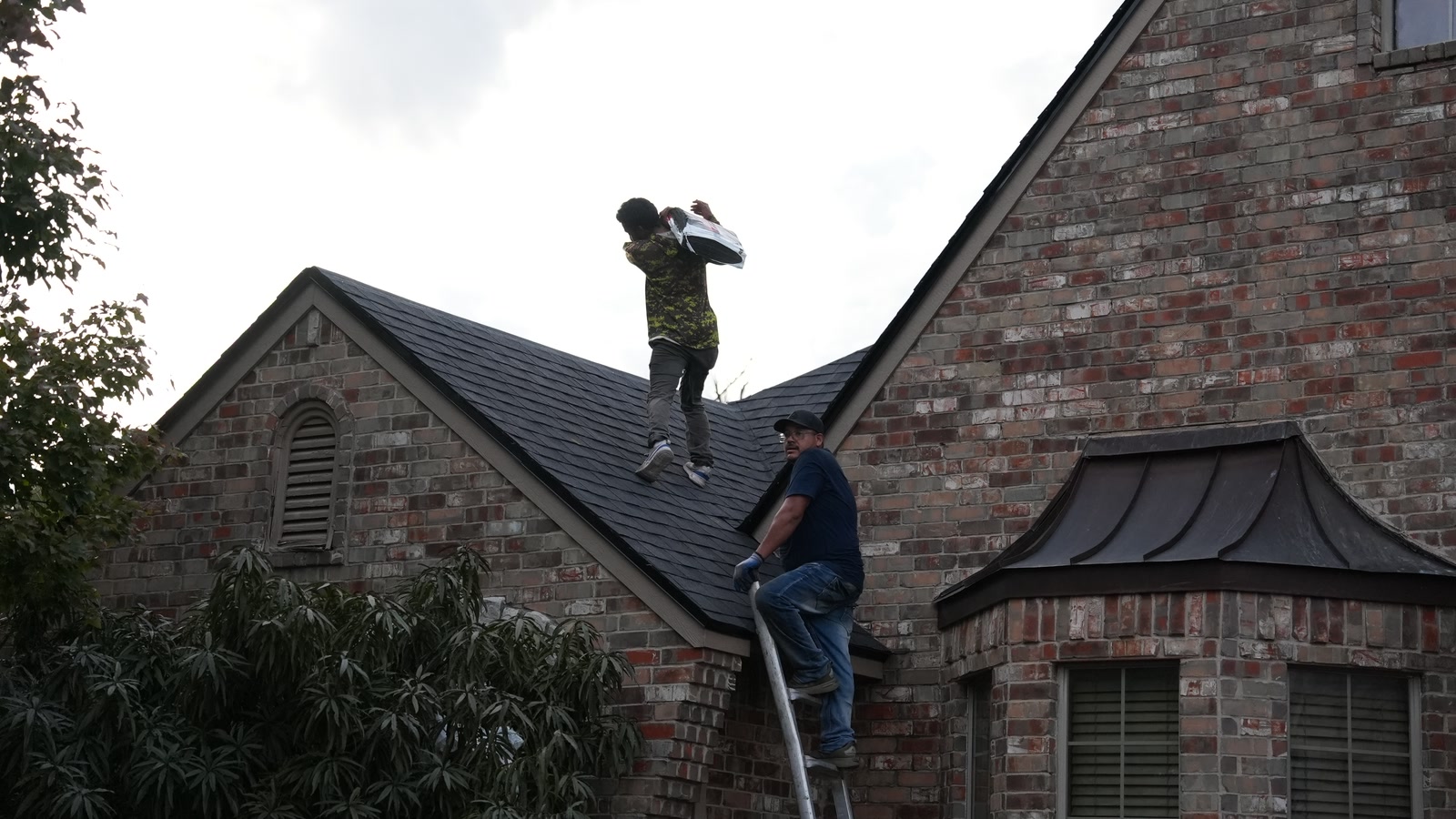
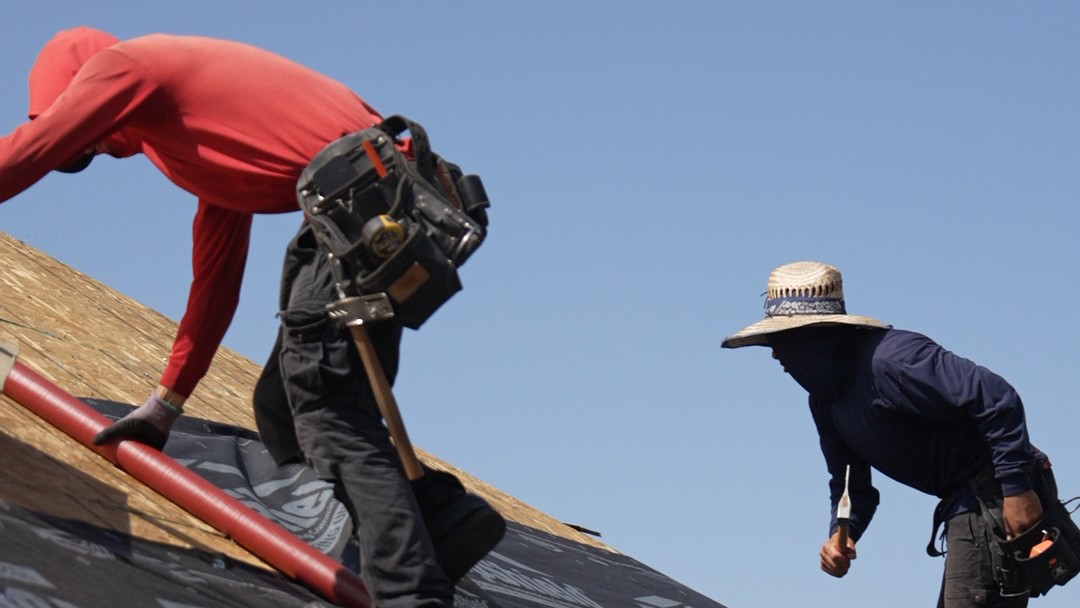
Edmond re-roof, October 2026: roofer carrying a shingle bundle onto a steep roof while a second crew member climbs the ladder
To set the spacing in your own yard:
- Read the nursery tag for the tree's mature height and spread, not its size today.
- Picture the crown at full size. Keep its outer edge clear of the roof, the gutters and any overhead lines.
- Leave room for roots away from the foundation, driveway and patio.
- Picture where a broken limb would fall. It should land in the yard, not on the house.
A young tree planted close to the house looks fine at first. The trouble shows up years later, when the branches spread over the shingles.
What are the best trees to plant near a house in Oklahoma?
The best trees to plant near an Oklahoma house are ones that fit their spot at full size. The same guide matches tree types to places around the home:
| Spot | What the guide suggests | What it means for the roof |
|---|---|---|
| Under or near power lines | Short flowering trees | Small crowns stay below the lines and off the roof |
| South side, close to the house | Skip large evergreens, which block warming winter sun | Big evergreens close in also crowd and shade the roof |
| Southeast, southwest and west | Large deciduous trees for summer shade that still lets low winter sun through | Set them far enough out that mature limbs won't overhang |
| North side | An evergreen windbreak against cold winter winds | Plant the row out in the yard, not against the wall |
The guide also warns that large trees planted under utility lines can end up mutilated as they reach maturity. A short flowering tree in that spot avoids the problem for the tree and keeps limbs away from the house.
Why do Oklahoma ice storms make tree spacing matter?
Oklahoma ice storms are a big reason tree spacing matters for roofs here, because ice adds weight to every branch. In December 2007, the National Weather Service office in Tulsa recorded one to two inches of ice on trees and power lines along a Bristow-Tulsa-Vinita-Miami line. In October 2020, the National Weather Service office in Norman reported freezing rain of at least 1.5 inches in west-central and central Oklahoma. Storm reports from that event included tree limbs that punctured holes in roofs of homes.
The National Weather Service notes that heavy ice can bring down trees and topple utility poles. For your roof, that means a limb that clears the shingles in summer can sag onto them under ice. Limbs that hang over the house have nowhere to land but the roof. If you plan to plant this fall, pick the spot with an icy winter in mind. The post on checking a roof after an ice storm covers what to look for once one passes.
What should you do about tree branches touching the roof?
Tree branches touching the roof are worth planning around before they wear on the shingles. Branches that rub in the wind can scuff shingles and loosen granules. Leaves and twigs collect in valleys and gutters and hold water. Heavy shade keeps parts of the roof damp longer after rain.
A simple plan:
- From the ground, note which limbs touch or hang over the roof, and take dated photos.
- Stay off the roof and off ladders. Trimming at roof height is work for a professional.
- Keep well away from any branch near a power line, and contact your electric utility about it.
- Schedule trimming in fall, when leaves are down and limbs are easy to see.
- Have the roof under trimmed limbs checked for wear.
Black Crown Construction's roofing and construction services include tree service as well as roofing.
When should a roofer check the roof under your trees?
A roofer should check the roof under your trees when you notice changes you can see from the ground or from inside. Signs worth a look:
- A branch resting on the shingles, or a fresh scrape near the edge
- Shingles that look worn, lifted or out of line under an overhanging limb
- Leaves, twigs or moss built up in valleys or along the gutters
- Granules collecting at the downspouts
- Water stains on a ceiling or in the attic below a shaded area
- A limb that came down on the roof during wind or ice
On an inspection, a roofer checks shingles for scuffing and punctures. The roofer also looks at valleys, flashing and gutters for debris and damage, and checks the attic for signs of leaks. If the roof needs work, the roof repair services page explains what repairs involve.
If a ground check turned up a branch on the shingles, worn spots under a limb or debris piling in the valleys, a roofer can tell you whether the roof needs repair before you plan the trimming. For homes in the Tulsa metro and Oklahoma City, Black Crown Construction will look at the roof and the trees around it on a free on-site estimate. Call (918) 212-4720 or set up a visit to look at your roof and trees.
OK Roofing Registration #80008030
Frequently asked questions
Can I trim tree branches over my roof myself?
Branches at roof height are a job for a professional. Cutting from a ladder or from the roof puts you in an unstable spot with a falling limb nearby. You can note which limbs touch the roof from the ground and take photos. If any branch is near a power line, keep away from it and contact your electric utility.
What kind of tree can go under power lines in Oklahoma?
Short flowering trees are the choice for spots under overhead lines, according to the right-tree, right-place guide shared by the Oklahoma Department of Agriculture. The guide warns that large trees planted under utility lines can end up mutilated as they grow. A small tree in that spot also keeps limbs farther from your roof.
Does a tree hanging over my roof mean I need a new roof?
Not by itself. An overhanging tree can scuff shingles, fill valleys with debris and keep the roof damp, but the effect varies a lot. A roofer can check the shingles, flashing, gutters and attic under the tree and tell you whether trimming and a repair are enough or whether more work makes sense.
Sources
- Oklahoma Department of Agriculture: The Right Tree for the Right Place (Arbor Day Foundation guide)
- National Weather Service Tulsa: Storm Data for December 2007, including the ice storm
- National Weather Service Norman: The Ice Storm of October 26-29, 2020
- National Weather Service: Ice Storms safety page